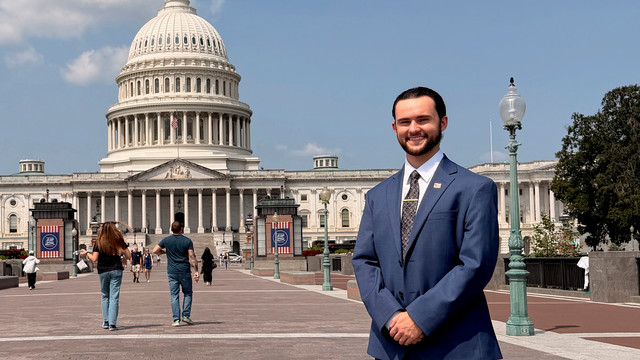
This award-winning scholar and industry expert is dedicated to improving global health by making pharmaceuticals more affordable.
Turn Your Education into a Career with Passion and Purpose.
You’re a Spider, so you dream big. You don’t want to land just any job after UR, but a purposeful career you’re passionate about.
A&S NEXT is coming up January 30–31, 2026, at the Virginia Crossings Hotel & Conference Center. This career program, specifically for A&S students, aims to give you the tools to understand how you can translate your education into a career you love while building your professional network.
The 2025–2026 Tucker-Boatwright festival dissects and expands the idea of Reconstruction to highlight the complex relationship to ongoing cultural movements and revolutions that we study, experience, and manifest through the visual arts. Reconstruction considers the many social, environmental, and political crises that we are experiencing today, and encourages us to look back at the histories that frame the urgent questions of our present for answers towards our future.
The Department of Art & Art History in partnership with The Harnett Museum, has invited two world renowned artists to campus, Cauleen Smith and Abigail DeVille, to interpret this theme through two new immersive installations that engage with local histories to create a space for community dialogue.
A&S students Brice Di Carlo, ’27, and Eric Zhou, ’27, have each been awarded a prestigious Beckman Foundation Scholarship to support faculty-mentored student research in the sciences.
Beckman Scholars are selected among undergraduate biology and chemistry students based on commitment to research, strong academics, and potential to become scientific leaders. UR has had 28 Beckman Scholars since 2006.
Chemistry major Brice Di Carlo is studying chemical bonding using various computational methods. This work of studying chemical structures and reactions has implications in developing new medicines and improving existing ones. His faculty mentor is chemistry professor Kelling Donald. Di Carlo plans to pursue a Ph.D. in medicinal chemistry and aspires to research drug development, including treatments for cardiovascular disease.
Eric Zhou is majoring in chemistry and minoring in physics. Under the mentorship of chemistry professor Wade Downey, he is studying organic chemistry — specifically indole synthesis, which has implications in the pharmaceutical industry. Zhou aspires to become a physician-scientist at an academic institution and hopes to open a lab researching targeted drug treatments for cancer.
The Faculty & Staff Research Symposium brings together colleagues from multiple disciplines, programs, and all five schools to present their research, work, and creative projects. All faculty and staff are invited to present their current work as part of interdisciplinary panels, roundtables, short-format sessions, or poster presentations.
The 2025-2026 academic year will feature the Mini Symposia on the following dates:
Do you envision college as a place where your professor’s office hours are spent in deep conversation about topics beyond this week’s assignment? Where you can work side-by-side with a faculty member on cutting-edge research that is published in a professional journal?
In A&S, our faculty are experts on the cutting edge of their fields. While they could work in some of the top research institutions in the world, our faculty chose Richmond because they believe in educating tomorrow's leaders and are passionate about mentoring and sharing their knowledge with students.
Mariama Rebello de Sousa Dias, associate professor of physics, published “Physics-informed generative adversarial networks applied to dichroic filters’ properties regression” in Physica Scripta.
Tianyuan Xu, assistant professor of mathematics & statistics, presented his research on orthogonal roots at The Interplay Between Distance Geometry, Combinatorics, and Coding Theory workshop held at the Brin Mathematics Research Center at the University of Maryland.
Kelling Donald, Clarence E. Denoon Jr. Chair in the Natural Sciences, published “Why are elements like radium dangerous? A chemist explains radioactivity and its health effects” in The Conversation.
Hemali Oza, assistant professor of health studies, published “Household resilience and adaptation strategies for enhancing access to energy, water, and food during droughts and floods: A qualitative study” in the International Journal of Hygiene and Environmental Health.